
Fire stopping maintains fire compartmentation by sealing penetrations and linear gaps to the required fire resistance, reducing fire and smoke spread and protecting escape routes. We install tested systems for cables, pipes, ducts and joints to deliver compliant, durable results.
- Maintains integrity and insulation ratings
- Reduces risk and meets specification
- Programme-friendly installation by trained operatives
Where We Apply Fire Stopping
Typical application scenarios where compliant sealing is essential:
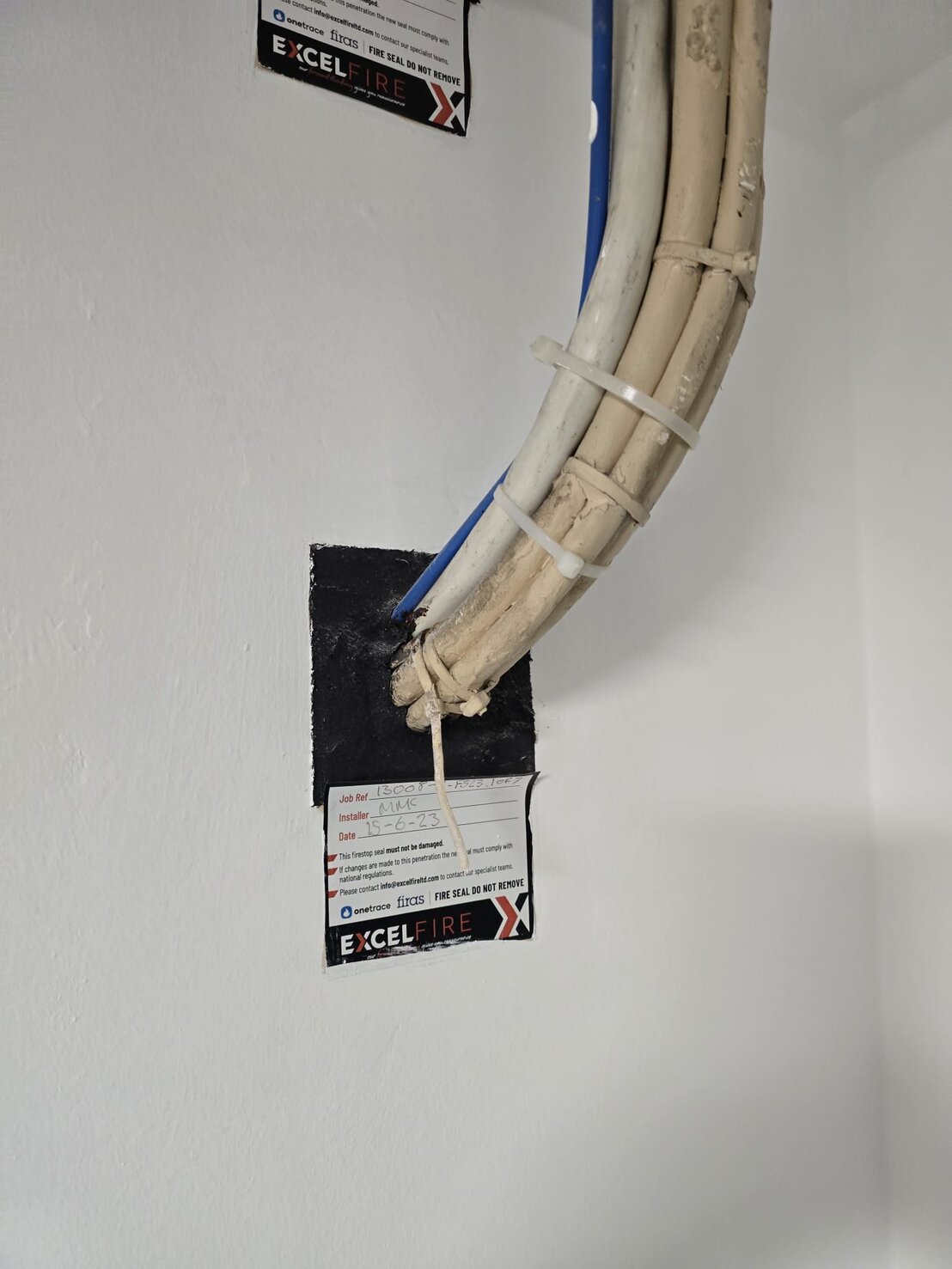
- Service penetrations: Cables, cable trays, plastic/metal pipes through walls and floors.
- Linear gap seals: Joints at wall–floor and wall–wall junctions; head-of-wall details.
- Risers and shafts: Multi-service risers, plant rooms and service cupboards.
- Perimeter fire barrier: Curtain wall edge-of-slab and façade interfaces.
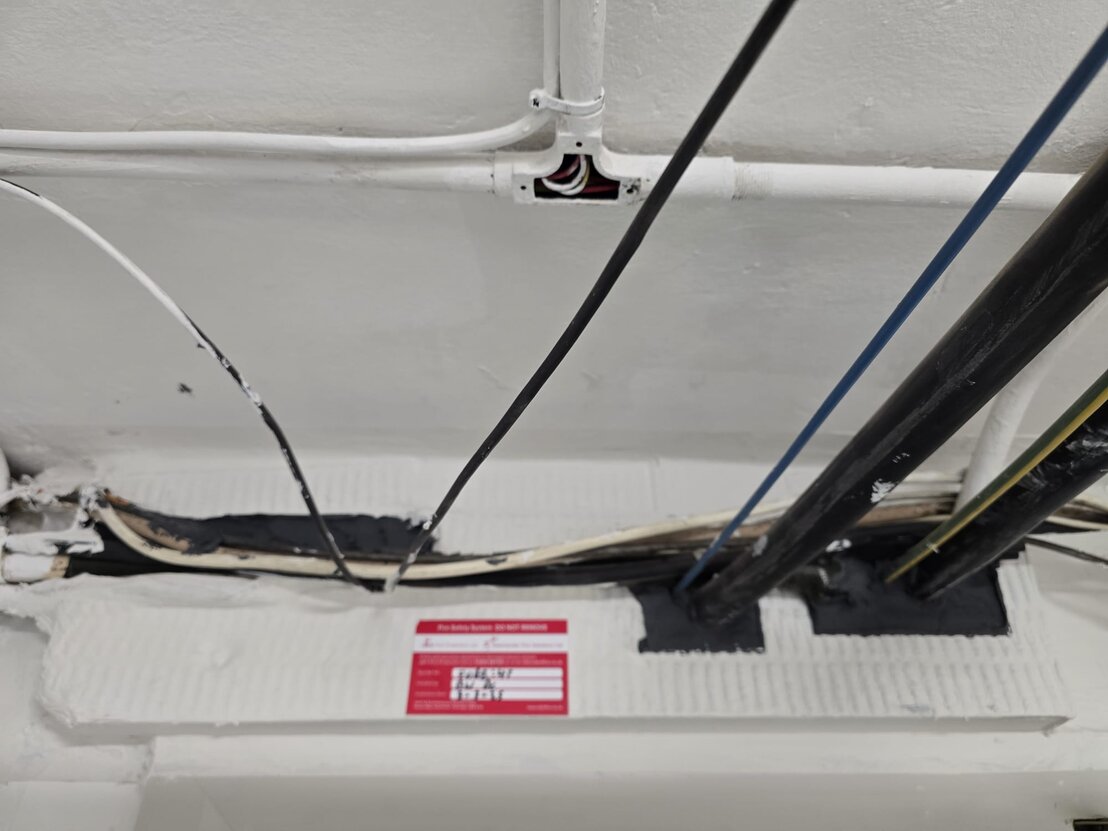
Systems and Materials We Use
We select tested systems matched to your substrates, service types and required fire ratings.
We work with leading, third-party-tested manufacturers to suit specification and programme.
- Fire batts with ablative coating for large or mixed penetrations.
- Intumescent sealants and acoustic mastics for linear joints and small gaps.
- Collars, wraps and sleeves for plastic pipes and combustible services.
- Mortars and fire-rated boards for floor penetrations and high-traffic areas.
- Graphite and acrylic seals around cables, trays and conduits.
We work with leading, third-party-tested manufacturers to suit specification and programme.

Compliance and Quality Assurance
Our installations follow tested details and robust QA to evidence compliance:
Need formal evidence? View our certifications and standards.
- Systems tested to EN 1366 and BS 476, installed to manufacturer guidance.
- Third-party accredited operatives and supervisors.
- Photographic QA, unique labeling and installation registers.
- As-built documentation and installation certificates on handover.
Need formal evidence? View our certifications and standards.
FAQs
What fire ratings can you achieve?
We install systems tested from 30 to 240 minutes of fire resistance, subject to substrate, service type and system selection.
Do you work as Principal Contractor or subcontractor?
We usually operate as a specialist subcontractor, coordinating with main contractors and MEP trades.
Can you work out of hours?
Yes—by agreement we can programme night or weekend works to minimise disruption.
We install systems tested from 30 to 240 minutes of fire resistance, subject to substrate, service type and system selection.
Do you work as Principal Contractor or subcontractor?
We usually operate as a specialist subcontractor, coordinating with main contractors and MEP trades.
Can you work out of hours?
Yes—by agreement we can programme night or weekend works to minimise disruption.
How do you evidence compliance?
Through photographic QA, unique labels, registers and handover certificates, aligned to EN 1366/BS 476 test data.
Which areas do you cover?
Primarily South East and London, with UK-wide mobilisation for projects by agreement.
For more, see the full FAQs page: Fire Stopping FAQs.
Through photographic QA, unique labels, registers and handover certificates, aligned to EN 1366/BS 476 test data.
Which areas do you cover?
Primarily South East and London, with UK-wide mobilisation for projects by agreement.
For more, see the full FAQs page: Fire Stopping FAQs.
Request a Quote
Get a fast, compliant proposal from Renbro Fire Protection Ltd.
- Send drawings, penetration schedules and fire strategy if available.
- Tell us programme dates, access constraints and site rules.
- We respond quickly with scope, methodology and lead times.